Delft Advanced Research Terra Simulator
Open-source simulation for next-generation subsurface energy
Build, extend and run multiphysics simulations in Python — from your laptop to HPC.
Geothermal · CO2 storage · Hydrogen · Reactive transport · THMC
pip install open-darts
Why open-DARTS?
| Conventional simulator | open-DARTS |
|---|---|
| Fixed physics | User-defined physics |
| Proprietary | Open source |
| CPU-centric | CPU + GPU |
| Separate module for each formulation | Fully coupled THMCS |
| Specialized simulator | Python-extensible framework |
See open-DARTS in action
Problems simulated with open-DARTS. Every animation comes from a model that you can run yourself following the 3 steps below. For the full tutorials, see the documentation.
Install
python -m pip install open-dartsUse a fresh virtual environment with a recent Python.
Get the examples
git clone -b main https://gitlab.com/open-darts/darts-models.gitReady-made models, including the teaching material.
Run a model
Pick a problem: each tab shows the animation, what it found and the command that runs it. Run times are measured on an AMD Ryzen Threadripper PRO 7945WX with 12 threads.
DARTS ecosystem
Five tools that work together. Choose one to see three papers behind it.
Capabilities and applications
Methods and applications from the first DARTS papers on: geothermal energy, CO2 and hydrogen storage, and subsurface monitoring, earlier and recent work side by side.
PhD theses
Doctoral theses at TU Delft that developed or applied DARTS, newest first.
- A thermodynamics-based simulation framework for modelling of geological CO2 sequestrationMichiel Wapperom · Defended 2026 · TU Delft repository ↗
- Improving uncertainty quantification of geological carbon storage with data assimilationGabriel Serrão Seabra · Defended 2026 · TU Delft repository ↗
- A finite volume framework for accurate modeling of fault reactivation in poroelastic rocksAleksei Novikov · Defended 2024 · TU Delft repository ↗
- General-purpose inverse modeling framework for energy transition applications based on adjoint method and operator-based linearizationXiaoming Tian · Defended 2023 · TU Delft repository ↗
- Modelling of coupled reservoir and wellbore for energy transitionKiarash Mansour Pour · Defended 2023 · TU Delft repository ↗
- Towards the uncertainty quantification of fractured karst systems: reactive transport and fracture networksStephan de Hoop · Defended 2022 · TU Delft repository ↗
- The impact of heterogeneity on geothermal production: simulation benchmarks and applicationsYang Wang · Defended 2021 · TU Delft repository ↗
- Simulation of foam in enhanced oil recovery (EOR) and carbon capture and storage (CCS) applicationsXiaocong Lyu · Defended 2021 · TU Delft repository ↗
- Delft Advanced Research Terra Simulator: general purpose reservoir simulator with operator-based linearizationMark Khait · Defended 2019 · TU Delft repository ↗
News
Releases, training workshops and conference talks, newest first.
- Open-DARTS 2.0 releasedA major release with the open-source solver stack and tons of new options for physics. Run your multi-million-cell model right after pip install, with hydrates, salts and hysteresis. See all details in the changelog.
- ECMOR 2026, PortoFive talks: geochemistry coupling, induced seismicity and DAS, coupled wells, CO2 hydrates, and LLM agents driving open-DARTS through an MCP server.
- SPE Reservoir Simulation Conference, GalvestonSeven talks: interpolation strategies for OBL, thermal-compositional CO2 storage in depleted fields, DARTS-well, the SPE11 convergence study with impurities, machine-learning-assisted upscaling, representative heterogeneity for direct-use geothermal, and physics-informed neural networks for CO2 flooding.
- DARTS-flash workshopTwo days at TU Delft celebrating the open-source DARTS-flash release, with talks from DTU, UiB, EBN and UPPA/TotalEnergies.
- Open-DARTS paper in JOSSThe software paper is published in the Journal of Open Source Software.
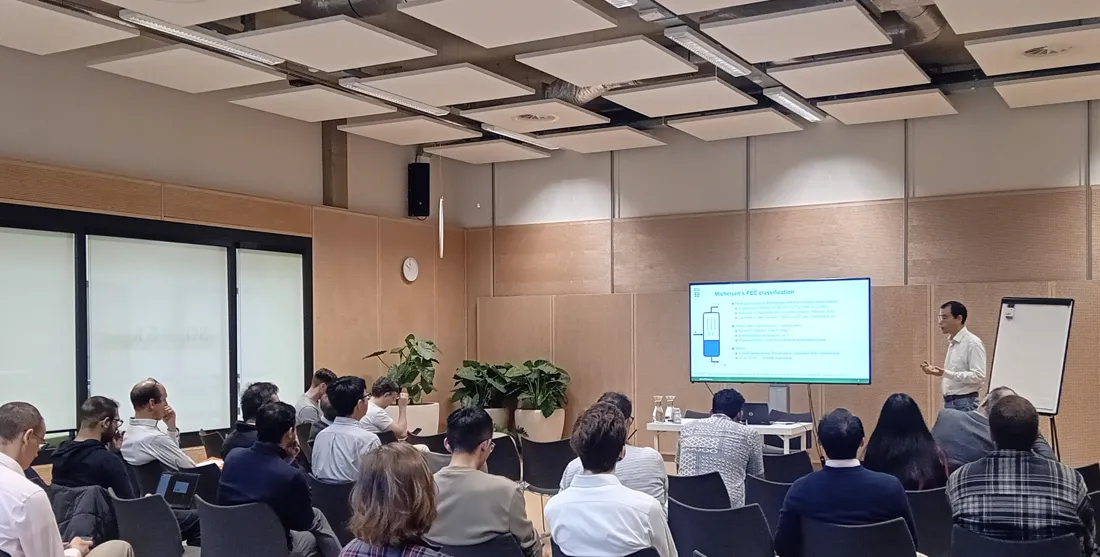
- First open-DARTS workshopMore than 50 participants: a day on open-source reservoir simulation and a day of hands-on training.
The team
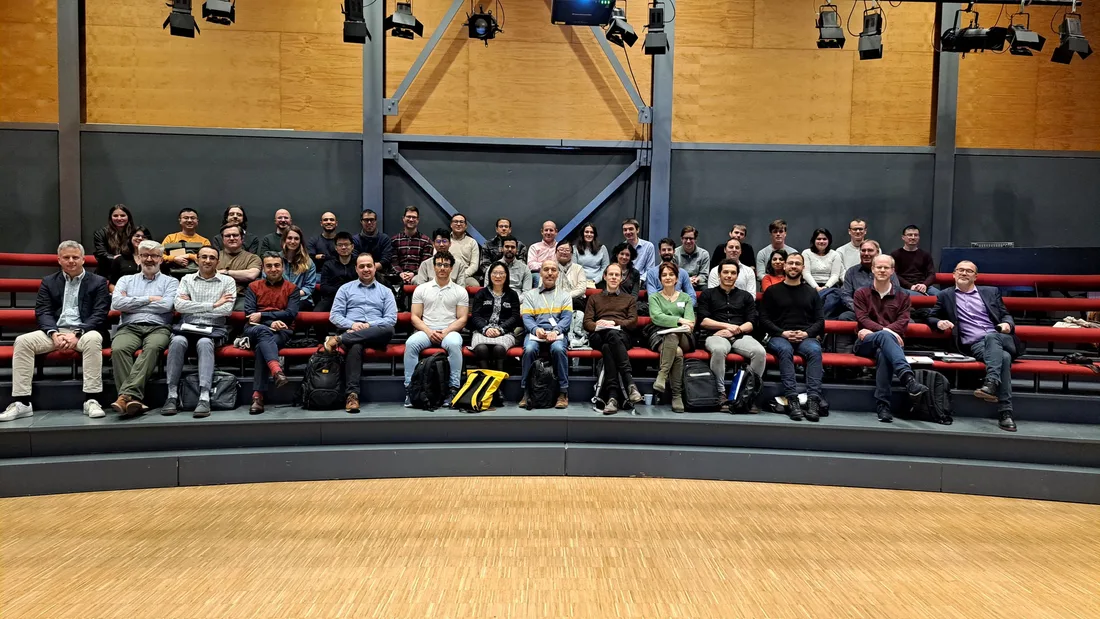
Researchers at the Department of Geoscience and Engineering, TU Delft, working with partners at Stanford University and in industry.
Former members
Contact us
Ran into a problem, or have a question? Send us an email and the team will get back to you.
darts@tudelft.nlTo help us help you
Include the version (pip show open-darts), your operating system and Python version, the full error message and, if you can, a small script that shows the problem.